
Most homemade fries go soft the second they hit the plate.
Mine don’t. 🍟
I spent way more Saturdays than I’d like to admit testing this recipe, and I finally cracked the code for fries that stay shatteringly crispy even after they cool down a bit.
The trick isn’t the oil. It’s not even the potato.
It’s one extra step almost nobody talks about, and once you know it, you’ll never make soggy fries again.
Recipe At a Glance
| Detail | Info |
|---|---|
| Prep Time | 20 minutes |
| Soak Time | 30 minutes (optional but worth it) |
| Cook Time | 25 minutes |
| Total Time | About 1 hour |
| Servings | 4 |
| Difficulty | Easy |
What You’ll Need
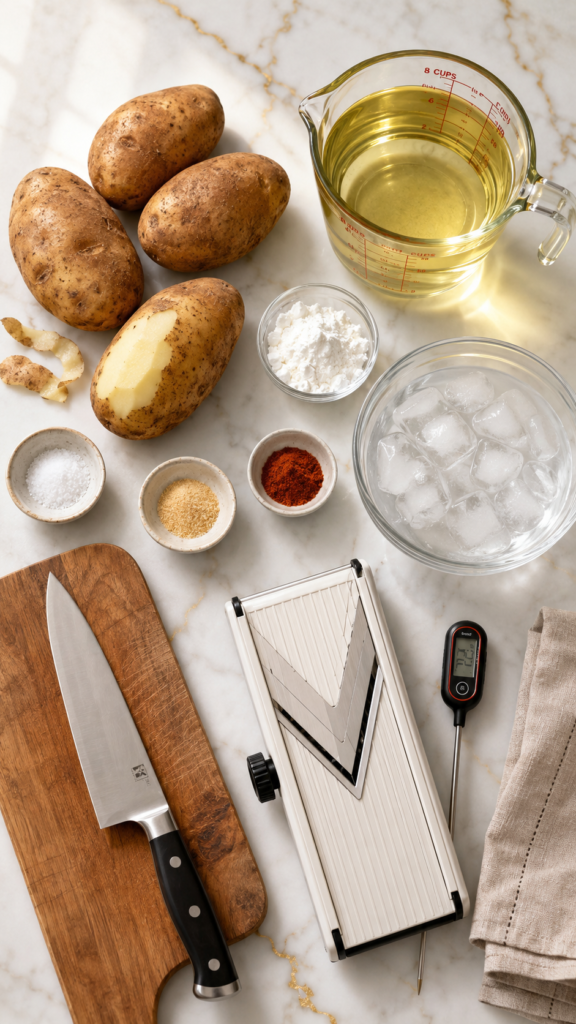
- 4 large russet potatoes
- 2 tablespoons cornstarch
- Vegetable oil or peanut oil (enough for frying, about 6 cups)
- 1 teaspoon fine sea salt (plus more for finishing)
- ½ teaspoon garlic powder (optional)
- ½ teaspoon smoked paprika (optional)
- Ice water, for soaking
That’s it. Seven ingredients, and two of them are optional.
Tools You’ll Need
- Sharp knife or a mandoline slicer
- Large bowl for soaking
- Deep pot or Dutch oven
- Kitchen thermometer
- Wire rack (this one matters, I promise)
- Paper towels
- Baking sheet
How To Make It
Step 1: Cut the Potatoes
Peel the potatoes if you prefer skinless fries (totally optional). Slice them into ¼ inch sticks, keeping the size consistent.
Step 2: Soak
Place the cut fries into a large bowl and cover with ice water. Let them soak for at least 30 minutes, or up to overnight in the fridge.
Step 3: Dry Them Off
Drain the fries and pat them completely dry with paper towels. Wet fries and hot oil are not friends, so don’t rush this part.
Step 4: Toss With Cornstarch
Toss the dried fries with the cornstarch until lightly coated. This is what gives you that extra crunch.
Step 5: First Fry (Low and Slow)
Heat your oil to 300°F. Fry the potatoes in small batches for 5-6 minutes, until they’re soft but still pale. Remove and place on a wire rack to cool for at least 10 minutes.
Step 6: Second Fry (Hot and Fast)
Increase the oil temperature to 375°F. Fry the potatoes again, this time for 2-3 minutes, until golden and crispy.
Step 7: Season Immediately
Pull the fries straight onto a wire rack lined with paper towels underneath. Sprinkle with salt (and garlic powder or smoked paprika, if using) right away.
Step 8: Serve Hot
Serve immediately for the best crunch, though these hold up surprisingly well even after a few minutes on the table.
Pro Tips
Here’s what I learned after burning through more potatoes than I want to count.
1. Cut them the same size. Uneven fries cook unevenly. Some end up burnt, some end up mushy. Aim for fries that are about ¼ inch thick.
2. Don’t skip the soak. Soaking pulls out extra starch, and that’s the difference between limp fries and crunchy ones.
3. Fry twice, not once. This is the real secret. One fry at a lower temp cooks the inside. A second fry at a higher temp crisps the outside. Skip this step and you’ll get soft, pale fries every time.
4. Salt them the second they come out of the oil. Salt sticks to hot oil way better than cooled oil. Wait too long and it just slides right off.
5. Never crowd the pot. Fry in small batches. Too many fries at once drops the oil temperature, and that’s basically a guarantee for greasy, sad fries.
Substitutions and Variations
You can play around here, and honestly, that’s half the fun.
- Sweet potato fries: Swap the russets for sweet potatoes. Skip the soak since sweet potatoes have less starch.
- Air fryer version: Toss the soaked fries in 1 tablespoon of oil, then air fry at 400°F for 15-18 minutes, shaking halfway.
- Baked fries: Bake at 425°F for 30-35 minutes on a wire rack, flipping once.
- Seasoning swaps: Try Cajun seasoning, ranch powder, or Parmesan and herbs right after frying.
- Gluten-free: This recipe is already gluten-free, since cornstarch is the thickener here, not flour.
Make-Ahead Tips
You can cut and soak the potatoes up to 24 hours ahead. Just keep them submerged in the fridge so they don’t turn brown.
You can also do the first fry (the low-temp one) a few hours ahead. Let them cool completely, then finish with the second fry right before serving.
Leftovers and Storage
Fries are best fresh, but leftovers happen.
- Fridge: Store in an airtight container for up to 3 days.
- Reheating: Skip the microwave, it turns fries rubbery. Instead, reheat in a 400°F oven or air fryer for 5-8 minutes until crispy again.
- Freezing: You can freeze the fries after the first fry only. Lay them flat on a baking sheet, freeze until solid, then transfer to a freezer bag for up to 2 months. Do the second fry straight from frozen when you’re ready to eat.
FAQ
Why are my fries soggy?
Usually it’s one of three things: not drying them enough before frying, skipping the double fry, or overcrowding the pot.
Can I use a different potato?
Russets work best because of their starch content, but Yukon Golds are a solid second choice.
What oil should I use?
Peanut oil and vegetable oil both have high smoke points, which makes them ideal for frying at these temperatures.
Do I really need a thermometer?
Yes. Guessing oil temperature is where most home fries go wrong. A cheap kitchen thermometer solves this instantly.
Can I make these without frying?
Yes, check the air fryer and baked versions above. They won’t be identical, but they’re still crispy and delicious.
Wrapping Up
Crispy fries at home aren’t complicated. They just need a little patience and that double fry trick.
Once you try it, you’ll wonder why you ever bought them frozen. 🙌
Give this recipe a try this week, then come back and drop a comment. Tell me how crispy yours turned out, or ask me anything if something didn’t go as planned. I read every comment and I’m always happy to help troubleshoot.