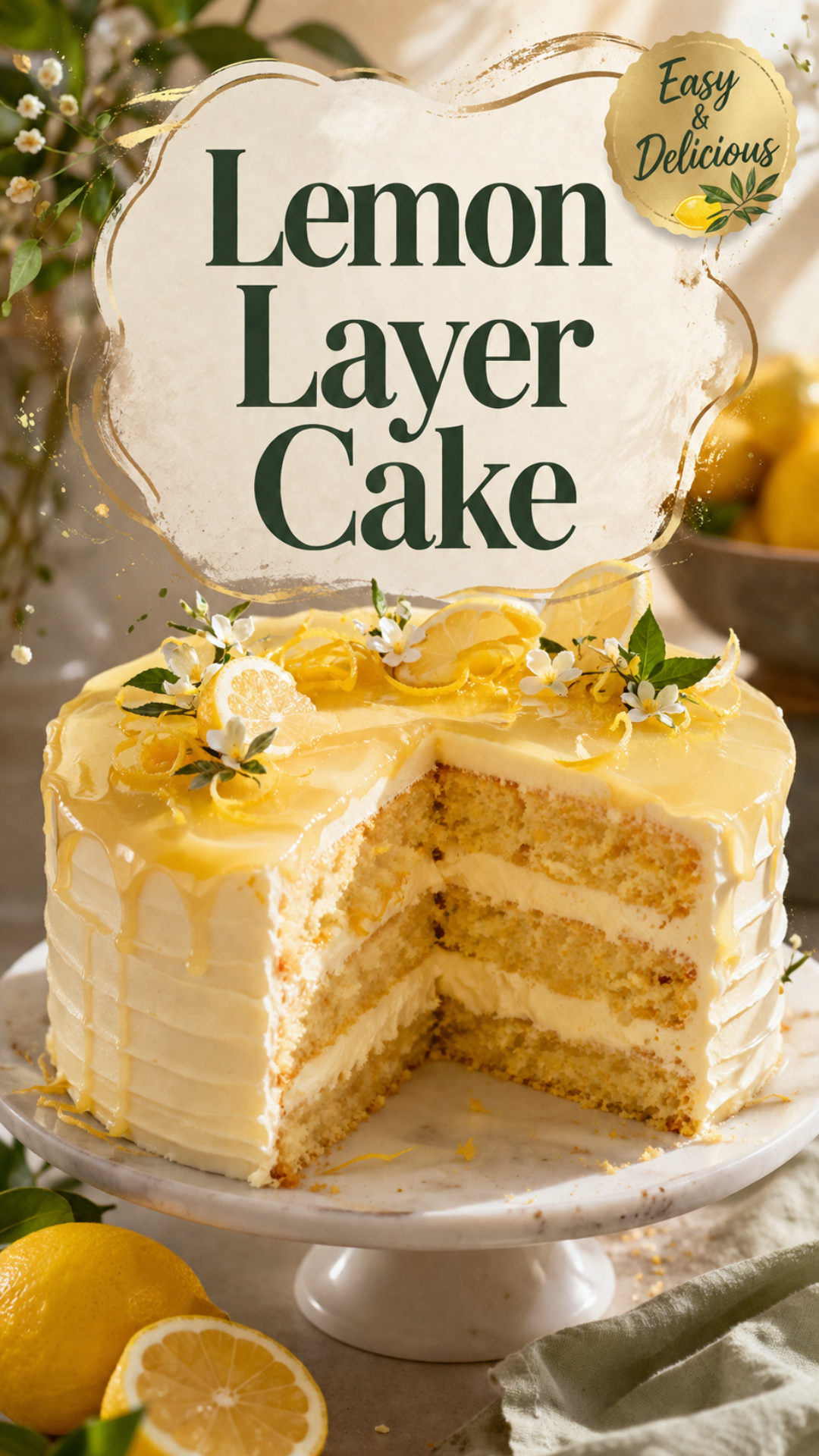
My grandmother had a recipe box with over 40 cakes in it.
Only one was lemon. And it’s the one everyone asked her to bring.
I’ve made this cake more times than I can count now, and I still get a little nervous every time I pour the batter into the pans. That’s how you know a recipe is actually good. 🍋
Here’s everything I’ve learned about making it right, including a few mistakes I made so you don’t have to.
Recipe at a Glance
| Detail | Info |
|---|---|
| Prep time | 40 minutes |
| Bake time | 28 minutes |
| Total time | 2 hours (with cooling and frosting) |
| Servings | 12 slices |
| Difficulty | Medium |
| Best for | Spring gatherings, birthdays, “I need something impressive” moments |
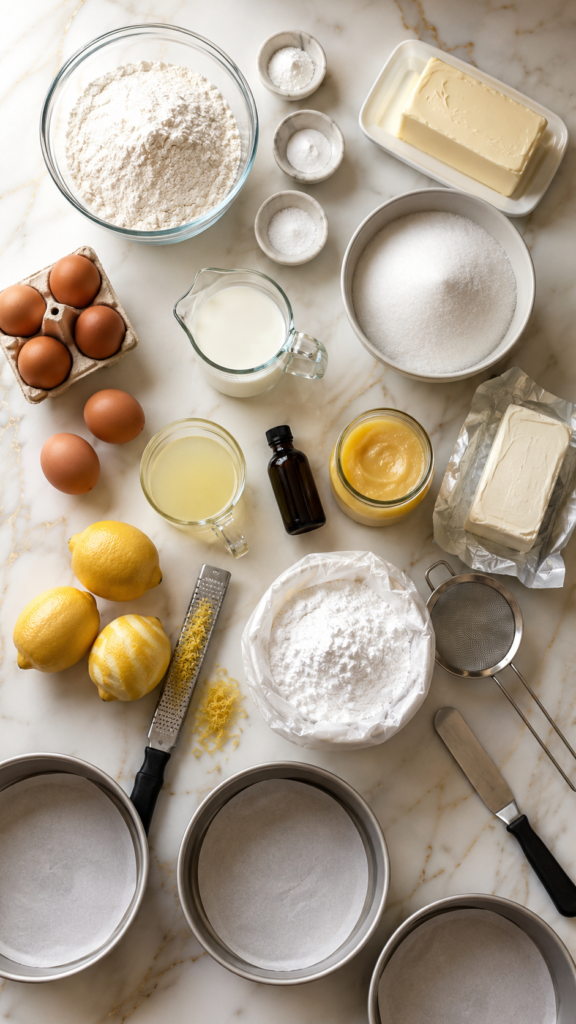
What You’ll Need
For the cake:
- 3 cups (360g) all-purpose flour
- 1 tablespoon baking powder
- 1/2 teaspoon baking soda
- 1/2 teaspoon salt
- 1 cup (226g) unsalted butter, softened
- 2 cups (400g) granulated sugar
- 4 large eggs, room temperature
- 1 cup (240ml) buttermilk
- 1/2 cup (120ml) fresh lemon juice
- Zest of 3 lemons
- 1 teaspoon vanilla extract
For the filling:
- 1 cup lemon curd (store-bought or homemade)
For the frosting:
- 1 cup (226g) unsalted butter, softened
- 8 oz (226g) cream cheese, softened
- 4 cups (480g) powdered sugar
- 2 tablespoons fresh lemon juice
- 1 teaspoon lemon zest
Tools You’ll Need
- Three 9-inch round cake pans
- Stand mixer or hand mixer
- Mixing bowls (large and medium)
- Zester or microplane
- Offset spatula
- Wire cooling racks
- Parchment paper
- Sifter
- Cake turntable (not required, but it makes frosting so much easier)
How to Make It
1. Prep your pans and oven. Preheat your oven to 350°F. Grease three 9-inch pans and line the bottoms with parchment paper.
2. Mix the dry ingredients. Sift together the flour, baking powder, baking soda, and salt. Set aside.
3. Cream the butter and sugar. Beat the butter and sugar together for a full 3 minutes, until it’s pale and fluffy. Don’t rush this part.
4. Add the eggs. One at a time, beating well after each addition.
5. Add the lemon zest and vanilla. Mix until combined.
6. Alternate the dry ingredients and buttermilk. Add the flour mixture in three parts, alternating with the buttermilk and lemon juice. Start and end with the flour.
7. Divide and bake. Split the batter evenly between your three pans. Bake for 25 to 28 minutes, until a toothpick comes out clean.
8. Cool completely. This step is non-negotiable. Let the layers cool in the pans for 10 minutes, then move them to a wire rack.
9. Make the frosting. Beat the butter and cream cheese together until smooth. Add powdered sugar gradually, then mix in the lemon juice and zest.
10. Assemble. Place one layer down, spread half the lemon curd on top, then a thin layer of frosting. Repeat with the second layer. Add the final layer and frost the whole cake.
Pro Tips
- Room temperature everything. Cold butter and cold eggs will not blend properly, and you’ll end up with a lumpy batter. Set everything out an hour before you start.
- Weigh your flour if you can. Scooping straight from the bag packs in extra flour and dries out the cake. A kitchen scale fixes this instantly.
- Zest before you juice. Once a lemon is squeezed, zesting it becomes nearly impossible.
- Let the curd chill before assembling. Warm curd will slide right off the cake layer and turn your frosting into a mess.
- Use a crumb coat. A thin frosting layer that chills for 15 minutes before the final coat gives you a much cleaner finish.
Substitutions and Variations
- Gluten-free: Swap in a 1:1 gluten-free flour blend. The texture stays close to the original.
- No buttermilk: Mix 1 cup milk with 1 tablespoon lemon juice or white vinegar, let it sit for 5 minutes.
- Dairy-free: Use vegan butter and a plant-based cream cheese alternative. The flavor holds up well.
- Extra tang: Add 1 more tablespoon of lemon zest to the batter for a stronger citrus punch.
- Berry twist: Layer fresh raspberries or blueberries between the cake and curd for a fruity contrast.
Make-Ahead Tips
- The cake layers can be baked up to 2 days ahead. Wrap them tightly in plastic wrap and keep at room temperature.
- You can also freeze the unfrosted layers for up to 2 months. Thaw overnight in the fridge before assembling.
- The frosting can be made 3 days ahead and stored in the fridge. Let it soften at room temperature before spreading.
Leftovers and Storage
Store the finished cake in an airtight container in the fridge for up to 5 days.
Let slices sit at room temperature for 20 minutes before serving. Cold cream cheese frosting tends to mute the flavor.
You can also freeze individual slices, wrapped tightly, for up to 3 months.
FAQ
Can I make this as a two-layer cake instead of three?
Yes. Divide the batter between two 9-inch pans and add 5 to 8 minutes to the bake time.
Why did my cake turn out dense?
This usually means the butter and sugar weren’t creamed long enough, or the flour was over-measured. Both affect how much air gets into the batter.
Can I use bottled lemon juice?
You can, but fresh juice makes a real difference here. Bottled juice tends to taste flatter and less bright.
My frosting turned out too soft. What happened?
Your butter or cream cheese was likely too warm. Chill the frosting for 15 minutes, then rewhip it.
How far ahead can I fully assemble this cake?
One day ahead, tightly covered in the fridge. Any longer and the curd starts to soften the cake layers.
Wrapping Up
This cake takes some effort. There’s no getting around that.
But it’s the kind of effort that pays off the moment someone takes their first bite and asks where you bought it.
Make it for someone who deserves a little extra. Then come back and tell me how it turned out, and drop any questions in the comments. I read every single one. 🍰