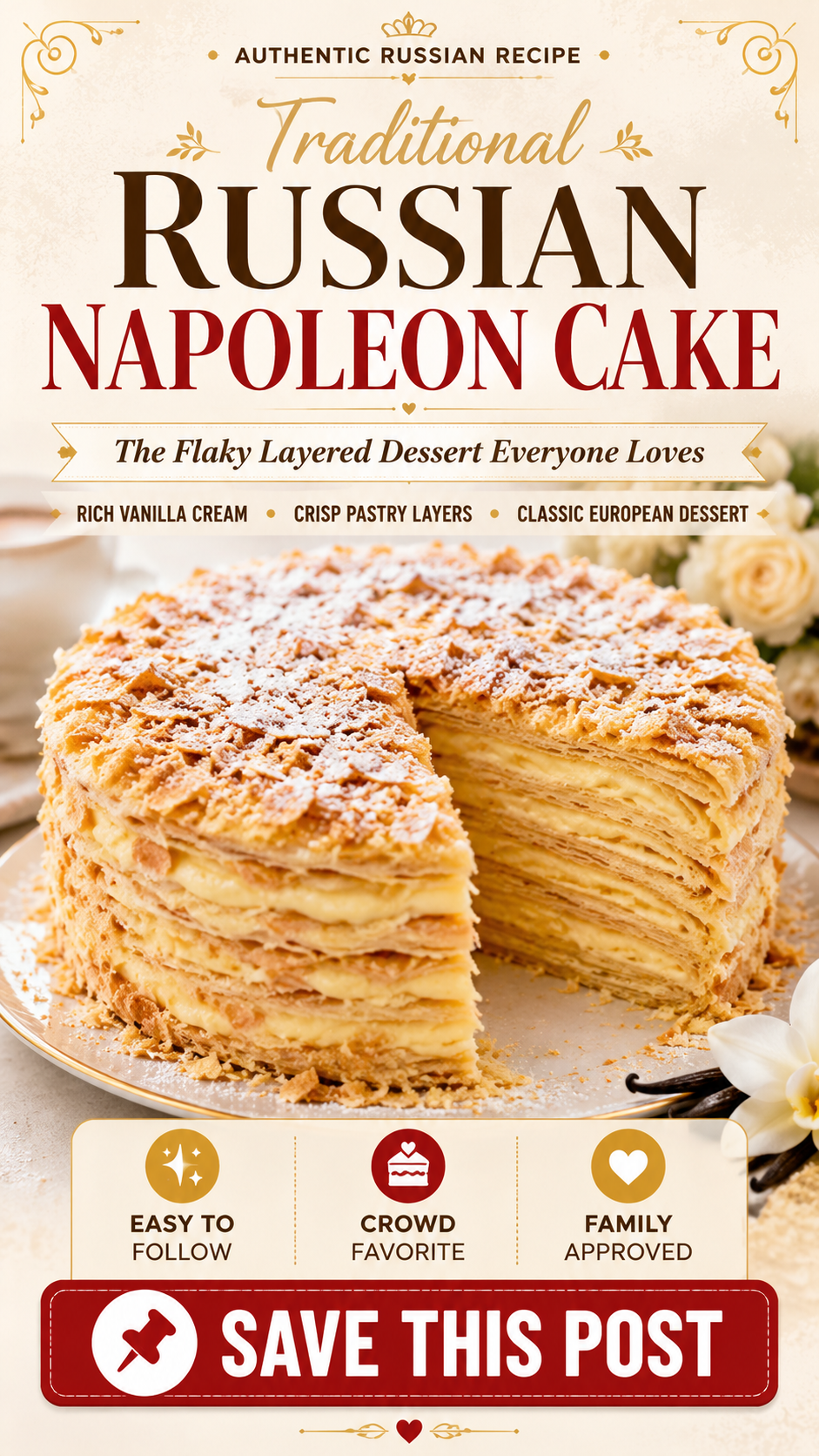
You’ve made birthday cakes. You’ve made chocolate lava cakes. Maybe you’ve even dabbled in cheesecake.
But nothing quite prepares you for Napoleon cake.
Twelve paper-thin layers of golden, flaky pastry. Rich, silky vanilla custard cream sandwiched between every single one. A crumbly pastry-crumb coating on top that makes you wonder why you ever bothered with frosting.
And the wildest part? It tastes even better on day two. 🤯
Recipe at a Glance
| Detail | Info |
|---|---|
| Prep Time | 1 hour 30 minutes |
| Chill Time | 8 hours (overnight) |
| Total Time | ~10 hours (mostly hands-off) |
| Servings | 10-12 slices |
| Difficulty | Intermediate |
| Best For | Birthdays, holidays, dinner parties |
What Is Napoleon Cake, Exactly?
This is not the three-layer French mille-feuille you may have seen in a Parisian bakery window.
Napoleon cake (known in Russia as Torte Napoleon) is a beloved Eastern European dessert with up to 15 ultra-thin puff pastry layers, each soaked in a buttery vanilla custard until the whole thing becomes impossibly soft and sliceable.
The cake was first created in 1912 to commemorate the centenary of Russia’s victory over Napoleon’s troops in 1812. The layers are said to represent the strength of the Russian people. The custard? The sweetness of triumph.
So yes. This cake carries actual history on every fork.
What You’ll Need
For the Puff Pastry Layers
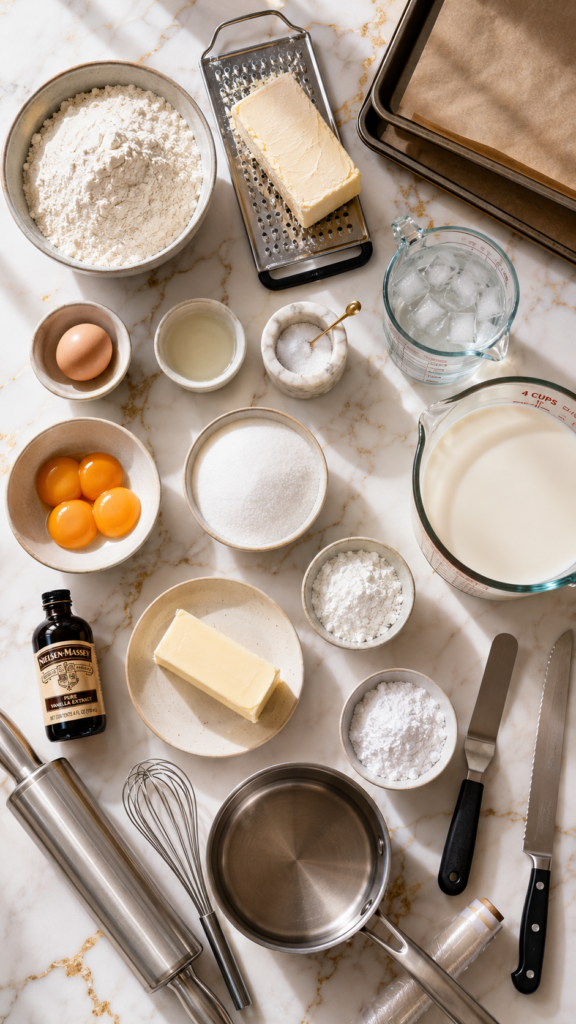
- 3 cups (375g) all-purpose flour, plus extra for dusting
- 1 cup (225g) cold unsalted butter, frozen and grated
- 1 large egg
- 1/2 tsp white vinegar
- 1/2 tsp salt
- 3/4 cup (180ml) ice-cold water
For the Custard Cream
- 4 cups (1 litre) whole milk
- 4 large egg yolks
- 1 1/4 cups (250g) granulated sugar
- 1/2 cup (60g) cornstarch (or all-purpose flour)
- 2 tsp pure vanilla extract
- 1/2 cup (115g) unsalted butter, softened and cut into pieces
For Assembly
- 2 tbsp powdered sugar (for the crumb topping)
- Powdered sugar for dusting (optional)
- Fresh berries for decoration (optional)
Tools You’ll Need
- Large mixing bowl
- Cheese grater (for the frozen butter)
- Rolling pin
- Baking trays (at least 2)
- Parchment paper
- Medium saucepan
- Whisk
- Offset spatula or butter knife
- Plastic wrap
- Refrigerator space for overnight chilling
- Serrated knife (for clean slices)
Pro Tips
These are the things no one tells you the first time, but you’ll wish they had.
- Freeze your butter solid. Grating it straight into the flour is the secret to those thousand flaky layers. If it softens mid-grate, toss it back in the freezer for 10 minutes.
- Don’t skip the overnight chill. It sounds painful to wait. Do it anyway. The cake actually tastes better after resting overnight, as the layers soften beautifully and the flavors meld together.
- Roll the dough thin, thinner, thinnest. You want sheets so thin you can nearly see through them. This is what gives you that melt-in-your-mouth texture instead of something stodgy.
- Temper your eggs slowly. When adding hot milk to the egg mixture, go slow. Pour it in a thin stream while whisking constantly. Rush it and you’ll scramble your eggs into the custard.
- Save one baked layer for crumbs. Intentionally overbake one sheet until it’s completely dry and golden. This is your crumb coating, and it makes the top of the cake look professionally done.
How to Make Napoleon Cake
Step 1: Make the Dough
Grate the frozen butter directly into the flour and salt. Use your fingertips to rub it in lightly until you have a shaggy, crumbly mix.
In a small bowl, whisk together the egg, vinegar, salt, and ice-cold water. Pour this into the flour mixture and stir until a dough just comes together. Do not knead it.
Shape into a rectangle, wrap in plastic wrap, and refrigerate for at least 2 hours (overnight is better).
Step 2: Make the Custard Cream
In a medium saucepan, heat 3 cups of the milk with the sugar over medium heat, stirring until the sugar dissolves. Bring to a gentle simmer.
In a bowl, whisk together the egg yolks, cornstarch, and remaining 1 cup of cold milk until smooth.
Slowly pour a ladleful of the hot milk into the egg mixture, whisking constantly to temper it. Then pour the whole thing back into the saucepan.
Cook over medium heat, whisking constantly, until the cream thickens to a pudding consistency. This takes about 3-5 minutes. Add vanilla extract and remove from heat.
Add the softened butter piece by piece, stirring until fully melted and smooth. Press plastic wrap directly onto the surface of the custard (this prevents a skin from forming) and refrigerate until completely cool, about 2 hours.
Step 3: Roll and Bake the Layers
Preheat oven to 400°F (200°C).
Divide the chilled dough into 12 equal pieces plus one extra small piece (for the crumb topping). Roll each piece into a thin rectangle or circle to fit your baking tray.
Prick each sheet all over with a fork. Bake for 10-15 minutes until golden and crisp. Let each layer cool completely on a wire rack before assembling.
For the extra small piece, bake until deeply golden and dry. Set aside for crumbs.
Step 4: Assemble the Cake
Place the first pastry layer on a serving plate or board. Spread a generous, even layer of custard cream on top.
Continue stacking, alternating pastry and cream, pressing gently with each layer.
Cover the top and sides with the remaining custard.
Step 5: Add the Crumb Coating
Break the reserved extra-baked pastry sheet into a zip-lock bag and crush it into fine crumbs with a rolling pin.
Mix with 2 tablespoons of powdered sugar and press the crumbs all over the top and sides of the cake.
Refrigerate overnight (or for a minimum of 8 hours). Resist the urge to cut into it before then.
Substitutions and Variations
You have more options here than you might think.
| Swap | For |
|---|---|
| Store-bought puff pastry | The homemade dough (saves 2 hours easily) |
| Cornstarch | All-purpose flour in the custard |
| Vanilla extract | 1 tbsp vanilla sugar or seeds from 1 vanilla pod |
| Heavy cream folded into custard | A lighter, fluffier filling |
| Condensed milk whipped with cream | A no-cook filling option |
| Sliced almonds pressed into crumb coat | Extra crunch and a nutty finish |
Gluten-free? Use a 1:1 gluten-free flour blend for the dough. The texture will be slightly different but still delicious.
Make-Ahead Tips
Napoleon cake was practically designed to be made ahead.
- The dough can be made up to 2 days in advance and stored wrapped in the fridge.
- The custard can be made the day before and kept covered in the fridge.
- The fully assembled cake is best made the night before serving. The flavors develop and the layers soften to perfection.
This makes it the easiest dinner party dessert you’ll ever prep stress-free.
Nutrition (Per Slice, Approx. 1/12 of Cake)
| Nutrient | Amount |
|---|---|
| Calories | ~480 kcal |
| Carbohydrates | ~52g |
| Fat | ~27g |
| Protein | ~7g |
| Sugar | ~22g |
Note: Values vary based on exact ingredients used.
Meal Pairing Suggestions
Napoleon cake is rich, so pair it with something light.
- A pot of Earl Grey or black tea (the classic Russian pairing)
- Espresso or a strong pour-over coffee
- Fresh berries on the side to cut through the richness
- A light sparkling wine for a dinner party dessert course
Leftovers and Storage
Napoleon cake keeps surprisingly well in the fridge.
- Store covered tightly in plastic wrap or in an airtight container.
- Keeps for up to 3 days in the refrigerator.
- Freezing: Not recommended. The custard can separate and become grainy when thawed.
- Serving from cold: Let it sit at room temperature for 10-15 minutes before slicing for the cleanest cuts.
Use a sharp serrated knife when cutting. Sawing gently through the layers beats pressing down and squishing everything.
FAQ
Can I use store-bought puff pastry?
Yes, and it’s a perfectly valid shortcut. Look for an all-butter puff pastry for the closest result to homemade. Roll it thin before baking.
Why are my layers sticking together oddly?
This usually happens if the custard was added while still warm. Always let the custard cool completely in the fridge before assembling.
How do I know the custard is thick enough?
It should coat the back of a spoon and hold a line when you drag your finger through it. If it’s still runny after 5 minutes of cooking, keep whisking over medium heat.
Can I make this with fewer layers?
Absolutely. Six to eight layers still produces a beautiful cake. You can make as few as 6 layers and still get great results.
My butter separated from the custard. What happened?
The most common cause is adding butter to the custard while it’s still too warm. If this happens, place the custard in an ice bath and whisk vigorously until it re-incorporates.
Does Napoleon cake taste better the next day?
Every single time. The pastry softens, the cream settles, and the flavors deepen overnight. Plan accordingly.
Wrapping Up
Napoleon cake is one of those recipes that feels like a project and tastes like a reward.
It is the kind of dessert that makes people go quiet at the table. The kind where someone will ask “wait, you made this?” and you’ll just smile.
The good news is that the actual active work is shorter than the recipe looks. Most of the time is resting, chilling, and waiting, which the cake handles all on its own while you go do something else entirely.
Make it the night before. Serve it cold. Watch what happens.
Then come back and tell me about it in the comments. I want to know how many layers you got, what you paired it with, and whether you managed to wait the full overnight before cutting in. (No judgment if you didn’t. I’ve been there.) 😄