
You know that feeling when you take one bite of something and you immediately want to make it again?
That’s this chicken lasagna.
It’s layered with tender shredded chicken, a creamy white sauce, rich tomato sauce, and so much melted cheese. It’s the kind of dish that makes your whole house smell incredible and has everyone asking for seconds before they’ve even finished their first plate.
And here’s the thing nobody tells you: chicken lasagna is actually easier to make than beef lasagna. No browning ground meat, no draining grease, just pull-apart, juicy chicken that practically melts into every layer.
Stick around because there’s a pro tip toward the end that genuinely changes how the cheese melts. It’s small, but it makes a big difference.
Recipe at a Glance
| Detail | Info |
|---|---|
| Prep Time | 30 minutes |
| Cook Time | 55 minutes |
| Total Time | 1 hour 25 minutes |
| Servings | 8-10 |
| Difficulty | Easy-Medium |
| Best For | Family dinners, meal prep, feeding a crowd |
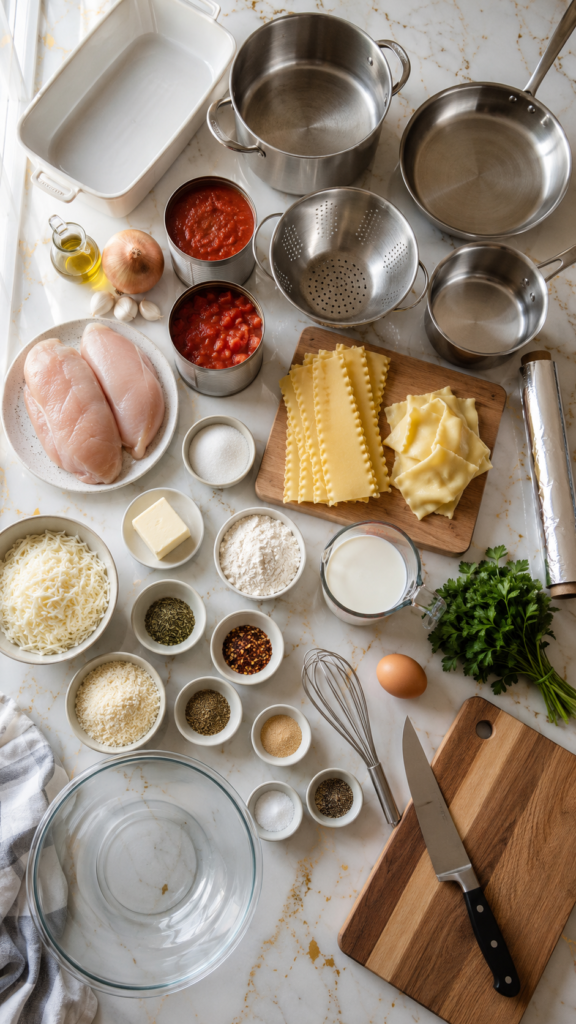
What You’ll Need
For the Chicken
- 2 lbs boneless, skinless chicken breasts (about 3 large breasts)
- 1 teaspoon garlic powder
- 1 teaspoon Italian seasoning
- Salt and black pepper to taste
For the Tomato Sauce
- 2 tablespoons olive oil
- 1 medium yellow onion, finely diced
- 4 garlic cloves, minced
- 1 can (28 oz) crushed tomatoes
- 1 can (15 oz) diced tomatoes
- 1 teaspoon dried basil
- 1 teaspoon dried oregano
- 1/2 teaspoon red pepper flakes (optional)
- Salt and black pepper to taste
- 1 teaspoon granulated sugar (balances acidity)
For the Béchamel (White Sauce)
- 4 tablespoons unsalted butter
- 1/4 cup all-purpose flour
- 2 1/2 cups whole milk (warmed)
- 1/4 teaspoon ground nutmeg
- Salt and white pepper to taste
For the Layers
- 12 lasagna noodles (regular or no-boil)
- 2 cups ricotta cheese
- 1 large egg
- 1/4 cup fresh parsley, chopped
- 3 cups shredded mozzarella cheese (divided)
- 1 cup freshly grated Parmesan cheese (divided)
Tools You’ll Need
- Large pot (for boiling noodles)
- Large skillet or saucepan (for the tomato sauce)
- Medium saucepan (for béchamel)
- 9×13-inch baking dish
- Colander
- Whisk
- Wooden spoon or silicone spatula
- Mixing bowls
- Aluminum foil
- Instant-read thermometer (optional but helpful)
- Sharp knife and cutting board
Pro Tips
These are the things that actually make a difference. Not just filler tips.
- Shred the chicken while it’s still warm. Cold chicken clumps and tears unevenly. Pull it apart right after cooking and it falls into perfect, ribbon-like pieces that layer beautifully.
- Don’t skip the béchamel. A lot of chicken lasagna recipes skip the white sauce and it’s always a mistake. The béchamel is what gives the lasagna that creamy, cohesive texture. It’s what makes it feel like a real restaurant-quality dish.
- Let the assembled lasagna rest for 15 minutes before cutting. This is the step most people skip and then wonder why their slices fall apart. Resting lets everything set up. You’ll get clean, picture-perfect slices.
- Season every layer. The sauce, the ricotta, the chicken. If you’re tasting your sauce and thinking “it needs something,” it probably needs more salt. Taste as you go.
- Cover with foil for the first 40 minutes, then uncover for the last 15. This prevents the cheese from burning before the center is fully cooked. You get perfectly golden, bubbly cheese on top every time.
How to Make Chicken Lasagna
Step 1: Cook the Chicken
Season the chicken breasts with garlic powder, Italian seasoning, salt, and pepper.
You can poach them in lightly salted water (about 15-20 minutes until cooked through) or bake them at 400°F for 22-25 minutes.
Once cooked, let them rest for 5 minutes and then shred using two forks. Set aside.
Step 2: Make the Tomato Sauce
Heat olive oil in a large skillet over medium heat.
Add the diced onion and cook for 5 minutes until softened. Add the garlic and cook for another 60 seconds.
Pour in both cans of tomatoes. Add basil, oregano, red pepper flakes (if using), sugar, salt, and pepper. Stir everything together.
Let it simmer on low for 20-25 minutes, stirring occasionally. The sauce should thicken and deepen in color.
Add the shredded chicken to the sauce and stir to combine. Take it off the heat and set aside.
Step 3: Make the Béchamel
Melt butter in a medium saucepan over medium heat.
Whisk in the flour and cook for 1-2 minutes until it looks slightly golden and smells a little nutty. This step cooks out the raw flour flavor. Don’t skip it.
Slowly pour in the warm milk, whisking constantly to prevent lumps. Keep whisking as the sauce thickens, about 5-7 minutes.
Season with nutmeg, salt, and white pepper. Set aside.
Step 4: Prep the Ricotta Layer
In a bowl, mix together the ricotta cheese, egg, and fresh parsley. Season with a pinch of salt and pepper. Set aside.
Step 5: Boil the Noodles (Skip if Using No-Boil)
Cook lasagna noodles in a large pot of salted boiling water according to the package directions, minus 2 minutes. They’ll finish cooking in the oven.
Drain and lay flat on a lightly oiled baking sheet to prevent sticking.
Step 6: Assemble the Lasagna
Preheat your oven to 375°F.
Lightly grease a 9×13-inch baking dish.
Layer order:
- Spread 1/2 cup of the chicken tomato sauce on the bottom of the dish
- Layer 3-4 lasagna noodles, slightly overlapping
- Spread 1/3 of the ricotta mixture
- Add 1/3 of the chicken tomato sauce
- Drizzle 1/3 of the béchamel
- Sprinkle 1 cup of mozzarella and 1/4 cup Parmesan
- Repeat layers twice more
- Top with the final noodles, remaining béchamel, remaining mozzarella, and remaining Parmesan
Step 7: Bake
Cover tightly with foil and bake for 40 minutes.
Remove the foil and bake for another 15 minutes until the cheese is golden and bubbly.
Remove from the oven and let it rest for 15 minutes before slicing. Seriously, don’t rush this part.
Substitutions and Variations
Protein swaps:
- Rotisserie chicken works perfectly here and cuts down your prep time dramatically
- Ground turkey is a great swap if that’s what you have on hand
- For a vegetarian version, swap the chicken for sautéed mushrooms, zucchini, and spinach
Cheese swaps:
- No ricotta? Cottage cheese works as a 1:1 swap (drain it first)
- Fontina or provolone can replace mozzarella for a more intense flavor
- Pecorino Romano instead of Parmesan adds a saltier, sharper kick
Noodle options:
- No-boil noodles are a great time-saver and work perfectly
- Gluten-free lasagna noodles work just as well here
- Zucchini slices can replace the noodles for a low-carb version
Sauce variations:
- Swap crushed tomatoes for jarred marinara if you’re short on time
- Add a splash of red wine to the tomato sauce for a deeper flavor
- Roasted red peppers in the sauce add a subtle sweetness
Make-Ahead Tips
This lasagna is actually better the next day. Everything has more time to meld together.
To assemble ahead: Build the lasagna up to 24 hours in advance, cover tightly with foil, and refrigerate. When ready to bake, add 10-15 extra minutes to the covered baking time since it’s going in cold.
To freeze: Assemble and freeze before baking. Wrap tightly in two layers of foil. It keeps well for up to 3 months. Thaw overnight in the fridge before baking.
The sauces: Both the tomato sauce and béchamel can be made 2-3 days ahead and stored separately in the fridge.
Nutritional Breakdown (Per Serving, Approximate)
Based on 10 servings
| Nutrient | Amount |
|---|---|
| Calories | ~485 kcal |
| Protein | ~38g |
| Carbohydrates | ~34g |
| Fat | ~22g |
| Saturated Fat | ~11g |
| Fiber | ~3g |
| Sodium | ~620mg |
Chicken lasagna is actually higher in protein than traditional beef versions, making it a more balanced option without sacrificing anything in the flavor department.
What to Serve with Chicken Lasagna
Keep it simple. This lasagna is a full meal on its own, so you just need a few sides to round things out.
- Garlic bread or focaccia for soaking up the extra sauce
- A simple arugula salad with lemon vinaigrette (the brightness cuts through the richness perfectly)
- Roasted cherry tomatoes for a little freshness
- A glass of Pinot Grigio or a light Chianti if you’re making it a proper dinner
Leftovers and Storage
In the fridge: Cooled leftovers keep in an airtight container for up to 4 days.
In the freezer: Slice into individual portions, wrap each one in plastic wrap, then foil, and freeze for up to 3 months.
To reheat: Cover with foil and bake at 350°F for 20-25 minutes. If reheating a single slice, the microwave works fine at 50% power in 90-second intervals. Covering with a damp paper towel prevents it from drying out.
One honest heads-up: the béchamel can separate slightly after freezing. It still tastes great, it just might look a little different when it comes out.
FAQ
Can I use store-bought rotisserie chicken?
Yes, and honestly it’s one of my favorite shortcuts for this recipe. Just shred it and add it to the tomato sauce exactly as you would with freshly cooked chicken. You’ll save yourself a solid 25 minutes.
My lasagna always comes out watery. What am I doing wrong?
A few things can cause this. First, if you’re using fresh vegetables in the sauce, they release a lot of water. Cook them down until most of that moisture evaporates before layering. Second, undercooking the tomato sauce leaves excess liquid. Let it simmer until it’s visibly thickened. Third, not letting the lasagna rest after baking means all the liquid runs out when you cut it.
Do I have to make the béchamel or can I skip it?
You can skip it, but the texture will be noticeably drier and less creamy. If making the béchamel feels intimidating, it’s actually one of the more forgiving sauces. As long as you whisk constantly while adding the milk, it won’t go wrong.
Can I make this dairy-free?
Yes. Use dairy-free butter, unsweetened oat milk or almond milk for the béchamel, a dairy-free ricotta (cashew-based ones work well), and your favorite vegan shredded mozzarella. The texture is slightly different but it’s still really good.
How do I know when the lasagna is done?
The cheese on top should be golden and bubbly. If you insert a knife in the center and it slides in with no resistance (no hard noodles), it’s done. Internal temperature should read around 165°F.
Can I add spinach?
Yes, and I’d actually recommend it. Stir a few large handfuls of fresh spinach into the tomato sauce after you add the chicken, or mix it into the ricotta layer. It wilts down to almost nothing and adds a nice earthy flavor.
Wrapping Up
Chicken lasagna deserves a permanent spot in your dinner rotation.
It’s comforting, genuinely satisfying to make, and it feeds a crowd without stressing you out. The layers of creamy béchamel, rich tomato sauce, and all that bubbly cheese hit differently than you’d expect from what sounds like a simple swap.
Once you make this, I have a feeling it’s going to become your go-to lasagna too.
Give it a try and drop a comment below telling me how it went. Did you add anything different? Make a substitution that worked really well? I’d love to hear it. And if you have any questions at all, just ask!