
You bite into one and the cream filling bursts out, and honestly? It’s kind of a life-changing moment.
Bomboloni are Italian-style filled doughnuts that originated in Tuscany, and they are wildly different from anything you’d grab at a drive-through. The dough is soft, pillowy, and lightly sweet. The filling is rich custard or jam. The sugar coating on the outside makes the whole thing feel a little indulgent and a little fancy at the same time.
And the wild part? They’re not complicated to make.
If you’ve never tried making doughnuts at home because you assumed it was some kind of professional kitchen endeavor, this recipe will completely change your mind.
Recipe at a Glance
| Detail | Info |
|---|---|
| Prep Time | 30 minutes |
| Rise Time | 1.5 to 2 hours |
| Cook Time | 20 minutes |
| Total Time | ~2.5 hours |
| Servings | 12 to 14 bomboloni |
| Difficulty | Intermediate |
| Best For | Weekend brunch, dessert, special occasions |
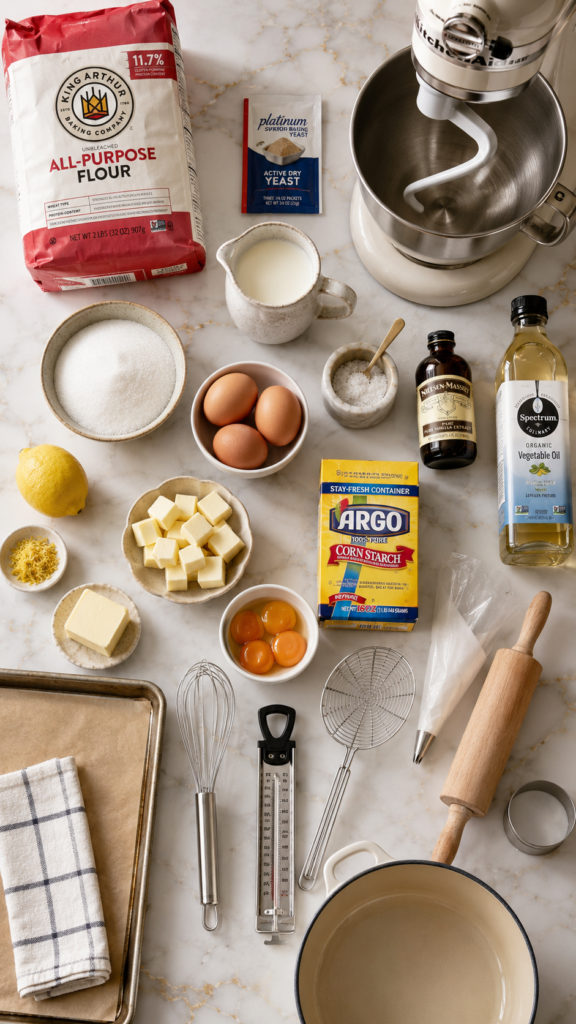
What You’ll Need
For the Dough
- 3 ½ cups (440g) all-purpose flour
- 2 ¼ tsp (7g) active dry yeast (1 packet)
- ½ cup (120ml) whole milk, warmed to 110°F
- ¼ cup (50g) granulated sugar
- 3 large eggs, room temperature
- 1 tsp fine sea salt
- 1 tsp pure vanilla extract
- Zest of 1 lemon
- 6 tbsp (85g) unsalted butter, softened and cut into small cubes
- Neutral oil for frying (vegetable or sunflower), about 4 cups
For the Pastry Cream Filling (Crema Pasticcera)
- 2 cups (480ml) whole milk
- 4 large egg yolks
- ½ cup (100g) granulated sugar
- ¼ cup (30g) cornstarch
- 1 tsp pure vanilla extract
- 2 tbsp unsalted butter
For Coating
- 1 cup (200g) granulated sugar (for rolling)
Tools Required
- Stand mixer with dough hook (or large bowl + hands)
- Medium saucepan
- Whisk
- Baking sheet lined with parchment paper
- Clean kitchen towels or plastic wrap
- Deep, heavy-bottomed pot or Dutch oven
- Candy/fry thermometer
- Spider strainer or slotted spoon
- Piping bag fitted with a long round tip (for filling)
- Rolling pin
- Round cutter, 3 inches in diameter
- Paper towels
Pro Tips
These are the things that would have saved me a lot of first-attempt frustration:
- Temperature is everything with yeast. Warm your milk to 110°F, not hotter. Too hot and you kill the yeast entirely. If you don’t have a thermometer, it should feel warm on your wrist but not hot.
- Don’t rush the rise. The dough needs that 1.5 to 2 hour rise to develop flavor and texture. A rushed rise gives you flat, dense bomboloni. Not ideal.
- Fry at exactly 350°F. Too hot and the outside browns before the inside is cooked through. Too cool and they absorb oil like a sponge. A thermometer is non-negotiable here.
- Make the pastry cream first. It needs to chill completely before you can fill the bomboloni, so get this done at the start, or even the night before.
- Roll gently and thick. Cut the dough to about ¾ inch thick. Thinner than that and you lose that satisfying pillow-like quality that makes bomboloni so good.
Substitutions and Variations
Don’t have everything on hand? Or want to mix things up?
Filling swaps:
- Nutella instead of pastry cream (kids go absolutely feral for this)
- Strawberry or raspberry jam for a classic Italian version
- Lemon curd for something brighter and more citrusy
- Whipped Nutella + cream cheese for an over-the-top version
Dough swaps:
- Bread flour instead of all-purpose gives a slightly chewier texture
- Dairy-free milk (oat milk works well) for a non-dairy version
Coating swaps:
- Cinnamon sugar instead of plain granulated sugar
- Powdered sugar for a lighter, more delicate finish
- A simple glaze made with powdered sugar + milk
Make-Ahead Tips
Bomboloni are genuinely best fresh, but life doesn’t always allow for that.
- Pastry cream: Make it up to 2 days ahead. Store in an airtight container with plastic wrap pressed directly on the surface to prevent a skin from forming.
- Dough: You can let it do its first rise in the fridge overnight (up to 12 hours). Pull it out an hour before you want to shape and fry.
- Shaped but unfried: Place the cut rounds on a parchment-lined tray, cover loosely, and refrigerate for up to 8 hours. Let them sit at room temperature for 30-45 minutes before frying.
How to Make Bomboloni
Step 1: Make the Pastry Cream
- Warm the milk in a saucepan over medium heat until it just starts to steam. Don’t boil it.
- In a bowl, whisk together the egg yolks, sugar, and cornstarch until pale and thick.
- Slowly pour about half the warm milk into the egg mixture while whisking constantly. This tempers the eggs so they don’t scramble.
- Pour the tempered mixture back into the saucepan with the remaining milk.
- Cook over medium heat, whisking constantly, until the cream thickens and just starts to bubble, about 3-4 minutes.
- Remove from heat, stir in the vanilla and butter until smooth.
- Pour into a bowl, press plastic wrap directly on the surface, and refrigerate until fully chilled (at least 1-2 hours).
Step 2: Make the Dough
- Combine the warm milk, yeast, and 1 tsp of the sugar in the bowl of your stand mixer. Let it sit for 5-10 minutes until it looks foamy. If nothing happens, your yeast may be dead and you’ll want to start over.
- Add the eggs, remaining sugar, vanilla, lemon zest, and salt to the yeast mixture.
- Add the flour and mix with the dough hook on low until a shaggy dough forms.
- Increase to medium speed and mix for 3 minutes.
- Add the softened butter a few cubes at a time, waiting until each addition is incorporated before adding more. This takes patience, about 8-10 minutes total.
- The finished dough should be smooth, slightly tacky, and pull away cleanly from the sides of the bowl. If it’s very sticky, add flour one tablespoon at a time.
- Shape into a ball, place in a lightly oiled bowl, cover with a damp towel, and let rise in a warm spot for 1.5 to 2 hours, until doubled in size.
Step 3: Shape the Bomboloni
- Turn the risen dough out onto a lightly floured surface. Don’t punch it down aggressively; be gentle.
- Roll to about ¾ inch thickness.
- Cut rounds using your 3-inch cutter. Re-roll scraps once to cut more rounds.
- Place cut rounds on a parchment-lined baking sheet, spacing them 2 inches apart.
- Cover loosely with a kitchen towel and let rest for 30-45 minutes until slightly puffed.
Step 4: Fry
- Pour about 3-4 inches of oil into your Dutch oven. Heat over medium to 350°F. Use the thermometer, not guesswork.
- Fry 2-3 bomboloni at a time for about 2-2.5 minutes per side, until deep golden brown.
- Transfer to a paper towel-lined tray to drain for just 30 seconds.
- While still warm, roll immediately in granulated sugar to coat on all sides.
- Set on a rack and repeat with remaining dough.
Step 5: Fill
- Transfer chilled pastry cream to a piping bag fitted with a long round tip.
- Use the tip to poke a hole into the side of each bombolone, angling slightly toward the center.
- Pipe filling in slowly until you feel the doughnut get slightly heavier and a tiny bit of cream starts to peek out at the opening.
- Serve immediately for the full effect. 🤌
Nutritional Breakdown (Per Bombolone with Pastry Cream)
| Nutrient | Amount (approx.) |
|---|---|
| Calories | 310 kcal |
| Total Fat | 14g |
| Saturated Fat | 6g |
| Carbohydrates | 40g |
| Sugar | 18g |
| Protein | 6g |
| Sodium | 160mg |
These are estimates and will vary depending on oil absorption and exact filling amount.
Dietary Notes and Meal Pairings
For a dairy-free version: Use oat milk in both the dough and pastry cream, and sub in dairy-free butter. The texture is a tiny bit different, but still really good.
For a lighter filling: Swap the pastry cream for a whipped ricotta sweetened with a little honey and vanilla.
Serve them with:
- A strong espresso or cappuccino (classic Italian move)
- A fresh fruit platter to cut the richness
- Hot chocolate for a full weekend brunch spread
Leftovers and Storage
Genuine truth: bomboloni are best eaten within a few hours of frying. After that, the texture starts to change.
That said, here’s how to handle leftovers without sadness:
- Room temperature: Store unfilled bomboloni in an airtight container for up to 1 day.
- Refrigerator: If already filled, refrigerate in a single layer for up to 2 days. They’ll soften but still taste great.
- Reheat: Pop them in a 300°F oven for 5-7 minutes to restore some of the exterior crispness.
- Freeze the dough: After the first rise, shape the rounds, place on a lined tray, and freeze. Once solid, transfer to a freezer bag. Fry from frozen (just add a minute or two to the fry time).
FAQ
Can I bake these instead of frying?
You can, but they won’t be the same. Baked bomboloni are closer to a dinner roll than a doughnut. Frying is what gives them that slightly crispy exterior and airy interior. If you’re going to make the effort, fry them.
My dough isn’t rising. What went wrong?
Almost always the yeast. Either it was old, or the milk was too hot and killed it. Always proof your yeast first (that foamy step in the recipe) and check the expiration date on the packet.
Can I use instant yeast instead of active dry?
Yes. Skip the proofing step and add instant yeast directly to the flour. Reduce rise time by about 15-20 minutes.
The filling is leaking out when I pipe it. Help.
Your pastry cream might not be chilled enough, or you may be piping too fast. Give it a full chill in the fridge (2+ hours), and pipe slowly with steady pressure.
Can I make the dough without a stand mixer?
Absolutely. It just takes more muscle. Knead by hand for about 10-12 minutes, then work the butter in by folding and pressing the dough repeatedly. It’s a workout, but it works.
How do I know when the oil is hot enough without a thermometer?
Drop a tiny piece of dough into the oil. If it sizzles immediately and floats to the top within a couple of seconds, the oil is ready. If it sinks and just sits there, the oil needs more time.
Wrapping Up
Bomboloni are the kind of thing that feel special to make and feel even more special to eat.
There’s something that happens when you pull a golden, sugar-coated doughnut off a tray, poke it full of cold custard, and take a bite right there at the counter. It’s not subtle. It’s very much the highlight of a Saturday morning.
If you make these, I really do want to hear how they went. Leave a comment below and let me know what filling you used, what you served them with, or if you had a moment of triumph when the dough finally doubled in size. Questions are welcome too.