
Have you ever eaten a dessert that wiggles when you tap the plate and somehow tastes even better than it looks? 🍮
That’s purin.
I first had it at a tiny café in Tokyo, tucked behind a train station I can’t even remember the name of. One bite in, and I was hooked for life.
It’s silky. It’s got that deep, slightly bitter caramel running through it. And it takes maybe 20 minutes of actual hands-on work.
Here’s the wild part: purin isn’t even originally Japanese. It showed up in the 1860s when a British visitor introduced Western-style pudding to Yokohama, and Japan just… perfected it.
So today, I’m walking you through how to make it at home. No fancy equipment. No hard-to-find ingredients. Just eggs, milk, sugar, and a little patience while it chills.
Let’s get into it.
Recipe At a Glance
| Detail | Info |
|---|---|
| Prep Time | 20 minutes |
| Cook Time | 45 minutes |
| Chill Time | 4 hours (or overnight) |
| Total Time | About 5 hours |
| Servings | 4 |
| Difficulty | Beginner-friendly |
| Storage | Up to 4 days, refrigerated |
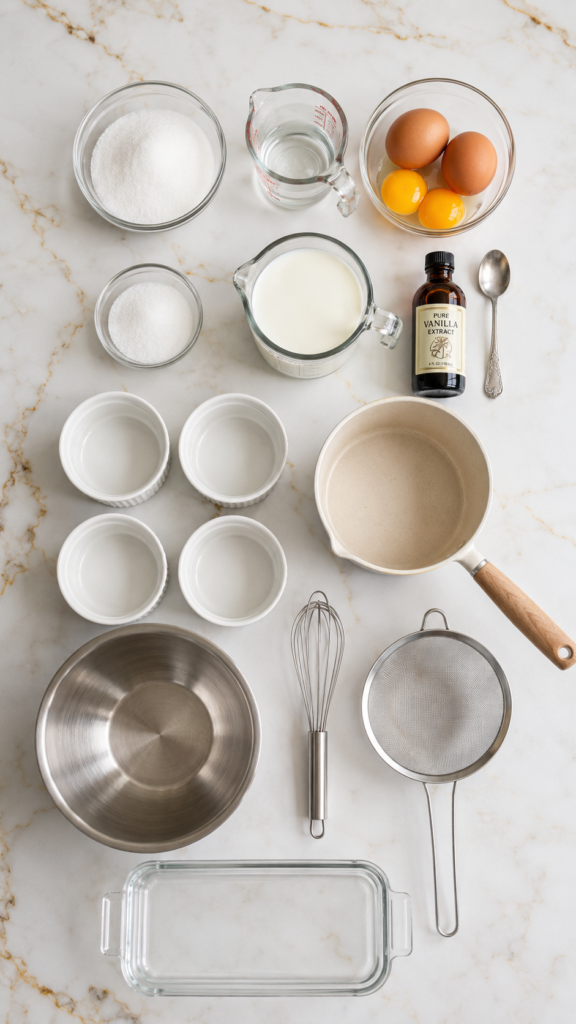
What You’ll Need
Purin is built from two parts: the caramel and the custard. Both are shockingly simple.
For the Caramel:
- ½ cup granulated sugar
- 3 tablespoons water (divided)
For the Custard:
- 2 whole eggs
- 2 egg yolks
- ⅓ cup granulated sugar
- 1 ½ cups whole milk
- 1 teaspoon vanilla extract
That’s it. Six ingredients total, and half of them are already in your pantry.
Tools You’ll Need
- 4 ramekins or heatproof cups (about 6 oz each)
- A small saucepan (light-colored, so you can see the caramel change color)
- A mixing bowl
- A fine-mesh strainer
- A baking dish large enough to hold all 4 ramekins
- A kettle or pot of hot water (for the water bath)
How to Make Japanese Purin
Step 1: Make the Caramel
Add the sugar and 1 tablespoon of water to your saucepan.
Heat over medium, swirling the pan gently instead of stirring with a spoon. Stirring can cause the sugar to crystallize, and nobody wants gritty caramel.
Once the sugar turns a deep amber (think the color of a copper penny), carefully add the remaining 2 tablespoons of water. It’ll bubble up fast, so stand back a little.
Stir it smooth, then immediately pour a thin layer into the bottom of each ramekin. Set them aside to cool while you make the custard.
Step 2: Make the Custard
Preheat your oven to 325°F (163°C).
In a bowl, whisk the eggs and egg yolks with the sugar until just combined. You don’t want to whip in a bunch of air bubbles here, so keep it gentle.
Warm the milk in a saucepan until it’s just steaming (not boiling), then slowly pour it into the egg mixture while whisking constantly. This step is called tempering, and it keeps your eggs from turning into scrambled eggs.
Stir in the vanilla, then pour the whole mixture through a strainer. This one step is the difference between a silky purin and a lumpy one.
Step 3: Bake in a Water Bath
Divide the custard evenly between your caramel-lined ramekins.
Place the ramekins in your baking dish, then pour hot water into the dish until it reaches about halfway up the sides of the ramekins.
Bake for 35 to 45 minutes. The custard is done when the edges are set but the very center still jiggles slightly, like gelatin.
Step 4: Chill
Let the ramekins cool at room temperature for about 30 minutes.
Then cover and refrigerate for at least 4 hours. Overnight is even better, since the caramel needs time to turn into that glossy sauce.
Step 5: Unmold and Serve
Run a thin knife around the edge of each ramekin.
Place a plate upside down on top, then flip the whole thing in one confident motion. Give it a little shake if it’s stubborn.
The caramel should come pooling out over the top like it’s been waiting all day to make its entrance.
Pro Tips
- Watch the caramel like a hawk. It goes from golden to burnt in about 10 seconds flat. Pull it right when it hits deep amber.
- Strain twice if you want bakery-level smoothness. It feels excessive, but the texture payoff is real.
- Don’t skip the water bath. It’s what keeps the custard silky instead of rubbery. Baking it dry basically guarantees a grainy texture.
- Test doneness with a gentle nudge, not a toothpick. A toothpick can leave a hole. Just jiggle the ramekin slightly and look for a wobble only in the center.
- Room temp eggs blend smoother. Pull them out of the fridge about 30 minutes before you start.
Substitutions and Variations
Purin is easy to riff on once you’ve got the base down.
- Dairy-free: Swap whole milk for full-fat oat milk or coconut milk. The texture stays close, though coconut milk adds its own flavor.
- Matcha purin: Whisk 1 to 2 teaspoons of matcha powder into the warm milk before combining with the eggs.
- Extra rich: Replace half the milk with heavy cream for a denser, more indulgent custard.
- No fine-mesh strainer? A regular strainer lined with a paper towel works in a pinch.
Make-Ahead Tips
Purin is honestly better the next day, since the caramel has more time to soften into sauce.
Make it up to 2 days ahead, keep it covered in the fridge, and unmold right before serving.
Leftovers and Storage
Purin keeps well in the fridge for up to 4 days, covered tightly.
I wouldn’t recommend freezing it. The texture turns watery and separates once thawed, which kind of defeats the whole point of a silky custard.
FAQ
Why did my purin turn out rubbery instead of silky?
This almost always means it baked too long or at too high a temperature. Pull it while the center still has a slight wobble.
Can I make purin without an oven?
Yes. You can steam it on the stovetop in a covered pot with a water bath instead, which is actually how a lot of Japanese home cooks make it.
What’s the difference between purin and flan?
They’re close cousins. Flan often uses condensed milk and is a bit sweeter, while purin tends to be lighter and less eggy in flavor.
Why is my caramel seizing up and turning hard?
That happens when cold water hits very hot caramel too fast. Add the water slowly and stand back, since it will bubble.
Did you know purin inspired a cartoon character?
Sanrio’s Pompompurin, a golden retriever in a caramel-colored beret, was literally named after this dessert back in 1996. He’s obsessed with pudding, which honestly checks out.
Wrapping Up
Purin looks fancy enough for a dinner party, but it’s genuinely one of the easiest desserts I’ve made from scratch.
Six ingredients. A little patience while it chills. And a payoff that tastes like something out of a Tokyo café menu.
Give it a try this week and let me know how it turns out in the comments. I’d love to hear if you stuck with the classic version or went rogue with a matcha twist. 🍮