
You’ve probably seen it in every trendy restaurant and on every “gut health” post lately. But kimchi isn’t a trend.
It’s been made in Korean households for over 2,000 years. And once you try making it at home, you’re going to wonder why you ever bought the jar version.
Fair warning though: it smells intense while it ferments. Your kitchen will have opinions. But the payoff? Completely worth it. 🙌
Recipe at a Glance
| Detail | Info |
|---|---|
| Prep Time | 45 minutes |
| Fermentation Time | 1 to 5 days |
| Total Active Time | Under 1 hour |
| Yield | About 1 quart (4-6 servings as a side) |
| Difficulty | Easy |
| Diet | Vegan (with substitution), Gluten-Free |
What Makes Kimchi Worth Your Time
Before we get into the recipe, here’s something most people don’t realize.
Kimchi is a probiotic powerhouse. One study from the Journal of Medicinal Food found that fermented kimchi contains live Lactobacillus bacteria that can actively support gut health, boost immunity, and even lower inflammation.
And it’s not just health. It’s flavor. That funky, spicy, tangy punch it adds to rice, eggs, noodles, tacos, you name it — it’s kind of addictive.
People spend $8 a jar for this. You can make a whole quart at home for under $5.
What You’ll Need
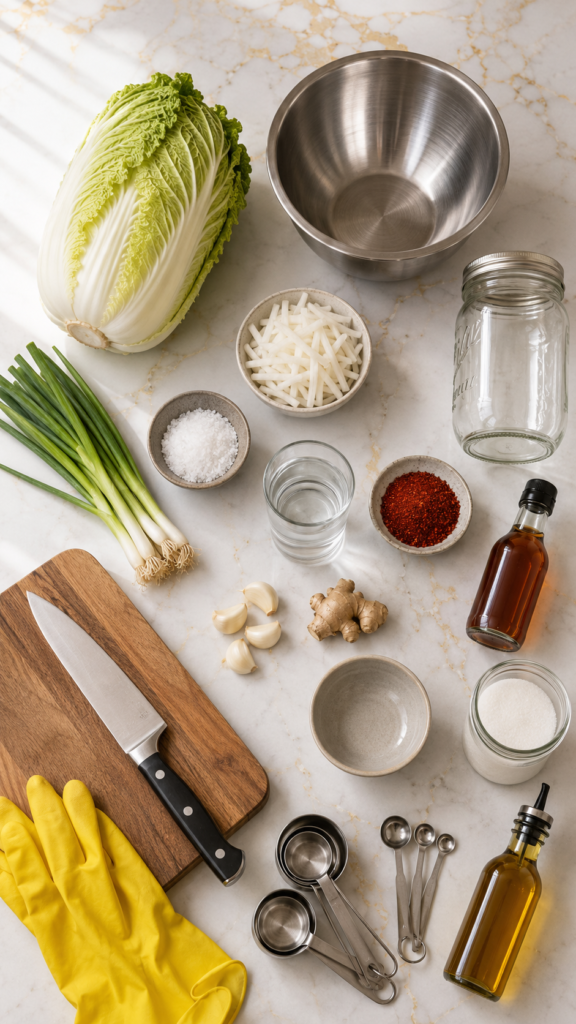
The Vegetables
- 1 medium napa cabbage (about 2 lbs / 900g)
- 1 cup daikon radish, cut into thin matchsticks
- 4 green onions, chopped into 1-inch pieces
The Salt Brine
- ¼ cup non-iodized coarse sea salt or kosher salt (iodized salt can mess with fermentation)
- 4 cups cold water
The Kimchi Paste (Gochujang Base)
- 3 tablespoons gochugaru (Korean red pepper flakes) — this is non-negotiable for the real flavor
- 1 tablespoon fish sauce (or soy sauce for vegan)
- 1 tablespoon sugar (white or brown both work)
- 4 garlic cloves, minced
- 1 teaspoon fresh ginger, grated
- 1 teaspoon sesame oil
- 2 tablespoons water (to loosen the paste)
Tools You’ll Need
- Large mixing bowl (the bigger the better — cabbage takes up space)
- Rubber gloves (seriously, don’t skip these — gochugaru stains everything)
- Sharp knife and cutting board
- Small bowl for the paste
- 1-quart mason jar with a lid
- Measuring cups and spoons
- A plate and something heavy to weigh down the cabbage while it salts
Pro Tips
These are the things that trip people up the first time:
- Don’t rush the salting step. The cabbage needs to sit in salt for at least 1-2 hours. This pulls out moisture and gives the kimchi its texture. If you skip or shorten this, it’ll end up mushy.
- Wear gloves when you mix the paste. Gochugaru will stain your hands orange. It will also burn if you accidentally touch your eyes. Gloves are not optional.
- Taste your paste before you add it to the cabbage. It should taste punchy, a little spicy, a little sweet. Adjust gochugaru or sugar here — it’s much easier than trying to fix it after.
- Leave room in the jar. Don’t pack it completely full. Kimchi releases gas and liquid as it ferments, and you’ll end up with kimchi all over your counter if the jar is overfull.
- Burp the jar once a day. Just open the lid briefly each day to release the buildup of gas. A quick twist of the lid and you’re done.
Substitutions and Variations
Vegan kimchi: Swap fish sauce for soy sauce or tamari. The flavor is slightly different but still really good.
Less spicy: Start with 1 tablespoon of gochugaru instead of 3. You can always add more paste next batch once you know your heat tolerance.
No daikon? Just leave it out. The kimchi will still be delicious.
Add extras: Some people throw in a little julienned carrot, cucumber, or even apple for a slightly sweeter version. All totally valid.
White kimchi (baekkimchi): Skip the gochugaru entirely for a mild, refreshing version that’s actually great with delicate dishes.
Make-Ahead Tips
Kimchi is literally designed to be made ahead.
Fresh kimchi (after 1 day) tastes bright and crunchy. After 3-5 days at room temperature, it develops that deeper, tangier fermented flavor most people associate with kimchi.
Once you hit your preferred level of tanginess, move it to the fridge. Cold temperatures slow fermentation dramatically, so it’ll hold for weeks without getting too sour.
Make a double batch. You’ll thank yourself later.
How to Make Korean Kimchi
Step 1: Cut the cabbage
Cut the napa cabbage into quarters lengthwise, then chop into roughly 2-inch pieces. You want bite-sized chunks, not too small.
Step 2: Salt the cabbage
In your large mixing bowl, dissolve the salt in the cold water. Add the cabbage pieces, making sure they’re fully submerged.
Put a plate on top and weigh it down with something heavy (a pot of water works great). Let it sit for 1-2 hours at room temperature.
You’ll notice a lot of water has been pulled out of the cabbage. This is exactly what you want.
Step 3: Rinse and dry
Drain the cabbage and rinse it under cold water 2-3 times to remove excess salt. Taste a piece — it should be pleasantly salty, not overwhelming.
Squeeze out as much water as you can with your hands, then let it sit in a colander for 10-15 minutes to drain further.
Step 4: Make the paste
In a small bowl, mix together the gochugaru, fish sauce (or soy sauce), sugar, minced garlic, grated ginger, sesame oil, and water. Stir until it forms a thick, cohesive paste.
Taste it. Adjust. This is your moment.
Step 5: Mix everything
Put on your gloves.
In the large mixing bowl, combine the drained cabbage, daikon matchsticks, and green onions. Add the paste and mix everything together thoroughly, making sure every piece of cabbage is coated.
This is a hands job. Dig in.
Step 6: Pack the jar
Transfer the kimchi into your mason jar, pressing it down firmly as you go to remove air pockets. Leave about an inch of headspace at the top.
Pour any remaining liquid from the bowl into the jar. The vegetables should be submerged under the liquid — this is what keeps it safe during fermentation.
Step 7: Ferment
Seal the jar loosely (not airtight) and leave it at room temperature, out of direct sunlight.
Taste it after 24 hours. If you like the fresh, bright flavor — it’s done. If you want more tang and depth, let it go another 1-4 days, tasting daily.
Step 8: Refrigerate
Once it’s at your preferred flavor level, seal the jar tightly and move it to the fridge.
Done. 🎉
Nutritional Breakdown
Per ½ cup serving (approximate)
| Nutrient | Amount |
|---|---|
| Calories | 23 |
| Carbohydrates | 4g |
| Protein | 1g |
| Fat | 0.5g |
| Fiber | 1.5g |
| Sodium | 390mg |
| Vitamin C | 18% DV |
| Vitamin K | 19% DV |
Kimchi is genuinely low-calorie, high in vitamins, and full of live cultures. It’s one of those rare foods that’s good and good for you.
What to Eat It With
This is where it gets fun.
- Classic: Served alongside steamed rice and Korean BBQ (bulgogi or galbi)
- Kimchi fried rice: Day-old rice, butter, kimchi, a fried egg on top. Probably one of the best 10-minute meals in existence.
- Kimchi grilled cheese: Yes, really. Sharp cheddar + kimchi in a butter-toasted sandwich is unreal.
- Ramen: Add a big spoonful to instant ramen and it completely changes the game.
- Tacos: A small amount on carnitas or fish tacos adds just the right punch.
- Eggs: Scrambled, fried, or in an omelette. Kimchi and eggs are underrated together.
Leftovers and Storage
In the fridge: Keeps well for up to 3 months. The flavor deepens and gets tangier over time. Some people specifically prefer “older” kimchi (called mukeunji) for cooking.
Freezing: Not ideal — the texture changes. Stick to fridge storage.
If it gets too sour: Use it for cooking instead of eating raw. Sour kimchi is incredible in kimchi jjigae (stew), kimchi pancakes, or fried rice.
The brine: Don’t toss it. Kimchi brine is great as a salad dressing base, a cocktail ingredient (yes, really), or a marinade.
FAQ
Do I need special equipment?
Not really. A large bowl, a mason jar, and gloves are about all you need. No fancy fermentation crock required.
Is it safe to ferment at room temperature?
Yes. Kimchi has been fermented this way for thousands of years. The salt and the acidic environment created by fermentation prevent harmful bacteria from growing.
What if I can’t find gochugaru?
Gochugaru is pretty widely available in Asian grocery stores and online. In a pinch, you can substitute gochujang (Korean chili paste) though the texture and heat level will differ. Regular chili flakes won’t give the same flavor.
How do I know if something went wrong?
Good kimchi smells sour, tangy, and garlicky. If it smells truly rotten or you see fuzzy mold (not just bubbles or white residue), toss it and start fresh. This rarely happens if you follow the salting and submerging steps correctly.
Can I make a small batch to test it first?
Totally. Cut the recipe in half and use a pint jar. Perfect for a first attempt.
How long until it’s ready to eat?
You can technically eat it immediately after mixing. But the fermented, tangy version most people love takes 1-3 days at room temperature.
Does homemade kimchi taste different from store-bought?
Very much so. Homemade kimchi is fresher, crunchier, and you can adjust the heat and tang to your exact preference. Store-bought tends to be more uniform and sometimes sweeter.
Wrapping Up
Kimchi is one of those things that sounds intimidating until you actually do it.
And then you realize it’s just cabbage, salt, and a punchy paste. That’s it. The fermentation does the rest.
Once you have a jar of homemade kimchi in your fridge, you’ll start putting it on everything. Eggs, rice, noodles, sandwiches — it makes everything taste just a little more alive.
Give it a try this week. And then come back and tell me: did you go fresh or let it ferment for the full 3 days? Did you add it to something unexpected? Drop your questions or your experience in the comments below — I’d love to hear how it goes. 👇