You’ve seen them stacked in pastel towers in every Parisian bakery photo that’s ever made you sigh at your screen. And if you’ve tried making them before and ended up with flat, cracked, or hollow little disasters, you’re not alone.
Here’s the thing though: French macarons are not as impossible as the internet makes them sound.
Once you understand why each step matters, it all starts to click. And when you pull that first perfect batch out of the oven and see those little ruffled feet? Chef’s kiss. Totally worth it.
Recipe at a Glance
| Detail | Info |
|---|---|
| Prep Time | 45 minutes |
| Rest Time | 30–60 minutes |
| Bake Time | 13–15 minutes per batch |
| Total Time | ~2 hours |
| Yield | 24 sandwich cookies (48 shells) |
| Difficulty | Intermediate |
| Best For | Special occasions, gifting, impressing everyone you know |
What You’ll Need
For the Macaron Shells
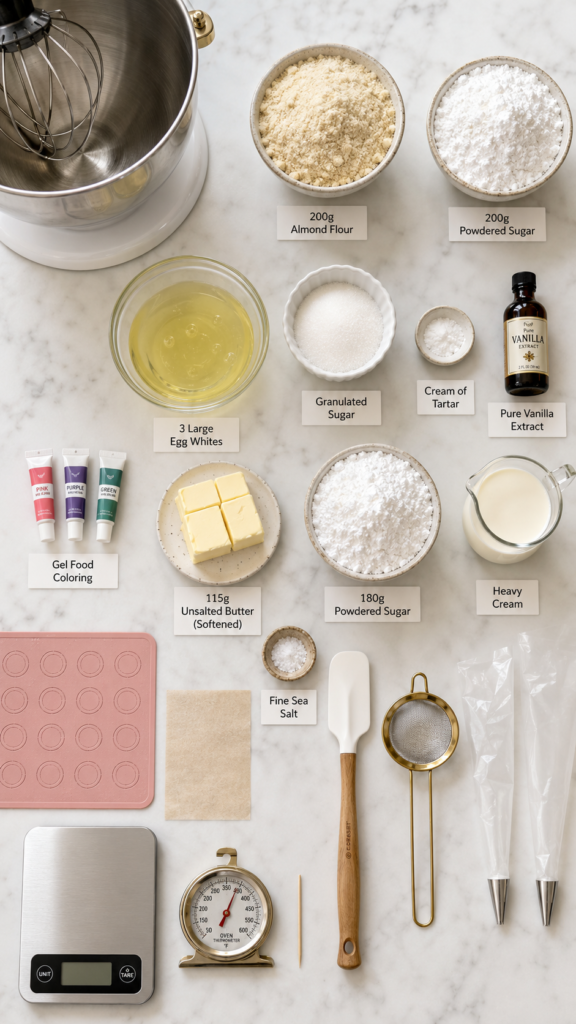
- 1 ¾ cups (200g) powdered sugar, sifted
- 1 cup (100g) almond flour, finely ground and sifted
- 3 large egg whites (aged at room temp for 24 hours, if possible)
- ¼ tsp cream of tartar
- ¼ cup (50g) granulated sugar
- ½ tsp pure vanilla extract
- Gel food coloring of your choice (optional)
For the Classic Buttercream Filling
- ½ cup (115g) unsalted butter, softened to room temperature
- 1 ½ cups (180g) powdered sugar, sifted
- 2 tbsp heavy cream
- 1 tsp pure vanilla extract
- Pinch of fine sea salt
Tools You’ll Need
- Stand mixer or electric hand mixer
- 2 large baking sheets
- Parchment paper or silicone macaron mats
- Piping bags (at least 2)
- Round piping tip, Wilton 1A or similar (about ½ inch opening)
- Kitchen scale (honestly non-negotiable here)
- Fine mesh sifter
- Rubber spatula
- Toothpick (for popping air bubbles)
- Oven thermometer (trust this more than your oven dial)
Pro Tips
These are the things that will save your first batch:
- Age your egg whites. Leave them uncovered in the fridge for 24–48 hours, then bring them to room temperature before whipping. This reduces moisture and makes for a more stable meringue. It feels fussy, but it genuinely makes a difference.
- Sift. Everything. Almond flour and powdered sugar both need to be sifted together at least once, ideally twice. Any lumps will show up on the surface of your shells and ruin that smooth top.
- Don’t over-macaronage. Macaronage is the folding step where you deflate the meringue into the dry ingredients. The batter should flow like lava and form a thick ribbon when you lift the spatula. If it’s still stiff and holds peaks, keep folding. If it runs off immediately like water, it’s gone too far. Aim for the ribbon.
- Let the shells rest before baking. Once piped, leave them on the counter for 30–60 minutes until a skin forms on top. You should be able to lightly touch them without batter sticking to your finger. This is what gives you that signature foot at the bottom.
- Know your oven. Most home ovens run hotter than they say. An oven thermometer takes the guesswork out, and baking at a lower temp (around 300°F/150°C) with a slightly longer time tends to give better results than a blazing hot oven.
Substitutions and Variations
Almond flour alternatives: If you have a nut allergy, sunflower seed flour works surprisingly well as a 1:1 swap. The flavor is slightly different but the texture holds up.
Dairy-free filling: Swap the butter for a high-quality vegan butter (Miyoko’s works great) and use full-fat coconut cream instead of heavy cream.
Flavor variations for the shells:
- Add 1 tbsp cocoa powder (reduce almond flour slightly) for chocolate macarons
- Add 1 tsp freeze-dried raspberry powder for a fruity version
- Use almond extract instead of vanilla for a more pronounced almond flavor
Filling ideas beyond buttercream:
- Lemon curd
- Nutella or chocolate ganache (melt 100g dark chocolate with 60ml heavy cream)
- Strawberry jam + cream cheese mixture
- Salted caramel
Make-Ahead Tips
Macarons actually get better with time.
Shells only: Baked and cooled shells can be stored in an airtight container at room temperature for up to 2 days, or frozen for up to 3 months.
Assembled macarons: Once filled, let them “mature” in the fridge for at least 24 hours before serving. The filling softens the shell slightly and the flavors come together. This is the French baker’s secret that most home recipes skip over.
Piped batter: Don’t pipe ahead and then refrigerate. Pipe and rest on the counter right before baking.
Full Instructions
Step 1: Prep Your Baking Sheets
Line two large baking sheets with parchment paper. If you have a macaron mat, even better, but parchment works perfectly. Set aside.
Step 2: Make the Almond Flour Mixture
Sift the almond flour and powdered sugar together into a large bowl. If you notice chunks of almond that won’t pass through the sifter, discard them. Sift a second time for the smoothest result. Set aside.
Step 3: Make the French Meringue
In a clean, grease-free bowl of your stand mixer, add the egg whites and cream of tartar.
Whip on medium speed until the mixture is foamy and opaque (about 2 minutes).
Slowly add the granulated sugar while the mixer runs, one tablespoon at a time. Increase speed to medium-high. Continue beating until you have stiff, glossy peaks that hold their shape when you pull the beater up.
Add vanilla extract and gel food coloring if using, and mix just until incorporated. The meringue should look like shaving cream, thick and shiny.
Step 4: Macaronage (The Folding Step)
Add the sifted almond mixture to the meringue all at once.
Using a rubber spatula, fold firmly from the bottom of the bowl, pressing the batter against the sides as you go. This is intentionally deflating the meringue.
Test as you fold: Lift the spatula and let the batter fall. It should flow off in a slow, thick ribbon and disappear back into the bowl within 10 seconds. This usually takes 40–55 strokes, but use the ribbon test, not a stroke count.
Step 5: Pipe the Shells
Transfer the batter to a piping bag fitted with a round tip.
Hold the bag perfectly vertical (90 degrees) directly over the baking sheet, about ½ inch above the parchment. Pipe 1.5-inch circles, keeping them evenly spaced.
Once piped, firmly tap the baking sheets against the counter 3–5 times to bring air bubbles to the surface. Pop any visible bubbles with a toothpick.
Step 6: Rest the Shells
Leave the piped shells uncovered at room temperature for 30–60 minutes, until a dry skin forms on the surface.
Preheat your oven to 300°F (150°C) during this time.
Step 7: Bake
Bake one sheet at a time on the middle rack for 13–15 minutes.
You’ll know they’re done when the feet are set, the tops don’t jiggle when you nudge the pan, and the shells lift cleanly off the parchment without sticking.
Let them cool completely on the pan before removing.
Step 8: Make the Buttercream
Beat the softened butter on medium speed until fluffy, about 2 minutes.
Add the sifted powdered sugar, heavy cream, vanilla, and salt. Beat on low to combine, then increase to medium-high for 2–3 minutes until light and smooth.
Step 9: Fill and Assemble
Pair up shells by size.
Pipe a small mound of buttercream onto the flat side of one shell. Press the matching shell on top gently, so the filling spreads just to the edges.
Refrigerate assembled macarons for 24 hours before serving. This step is optional but very much worth it.
Nutritional Breakdown (Per Macaron Sandwich)
| Nutrient | Amount |
|---|---|
| Calories | ~120 kcal |
| Total Fat | 6g |
| Saturated Fat | 2.5g |
| Carbohydrates | 16g |
| Sugars | 14g |
| Protein | 2g |
| Sodium | 15mg |
Values are approximate and vary based on filling choice.
Meal Pairing Suggestions
- Afternoon tea: Earl Grey or chamomile are the classic pairings. Lavender macarons with Earl Grey is a combination that feels absurdly elevated for a Tuesday afternoon.
- Dessert table: These fit beautifully alongside a cheese board, fresh fruit, and champagne for a celebration spread.
- Coffee: A strong espresso cuts through the sweetness perfectly.
Leftovers and Storage
In the fridge: Assembled macarons keep for up to 5 days in an airtight container. They actually peak in flavor on days 2 and 3.
In the freezer: Freeze assembled macarons in a single layer first, then transfer to an airtight container. They keep for up to 3 months. Thaw in the fridge overnight before serving.
Shells only: Unfilled shells keep at room temperature in an airtight container for 2 days.
Pro tip: Don’t store them near anything with a strong smell. Macarons absorb odors easily and you don’t want garlic-flavored macarons. 😬
FAQ
Why did my macarons crack on top?
Most likely the shells didn’t rest long enough before baking, so the skin hadn’t fully formed. It can also happen if your oven is too hot. Try resting them longer next time and use an oven thermometer to verify temperature.
Why don’t my macarons have feet?
Feet form when steam escapes through the sides of the shell during baking. No feet usually means the skin wasn’t dry enough before baking, or the oven temperature was off.
Can I use liquid food coloring?
It’s not ideal. Liquid coloring adds moisture to the meringue and can mess with the structure. Gel food coloring gives you vivid color without adding liquid.
My batter went runny. What happened?
Over-folding. Once it happens, there’s not much you can do. The best fix is to start fresh and fold more conservatively next time, testing with the ribbon method often.
Do I really need to age my egg whites?
Technically no, but aged whites whip up more stably. If you’re short on time, you can use fresh whites from the fridge and bring them to room temperature. You might just have a slightly less forgiving meringue.
Can I make them without a stand mixer?
Yes, a hand electric mixer works fine. Just make sure the bowl and beaters are completely clean and grease-free.
Why do my shells stick to the parchment?
They need more time in the oven or they weren’t cool enough before you tried to remove them. Let them cool completely on the pan.
Wrapping Up
If you’ve made it this far, you’re clearly serious about making these work. And the truth is? You absolutely can.
French macarons have a reputation for being tricky because most recipes skip the why behind each step. But once you get it, you get it. And your second batch will be infinitely better than your first.
Make them. Taste-test one straight from the fridge on day two. Then come back here and let me know how it went in the comments. I want to hear everything, the wins, the weird shapes, the color choices. Drop any questions you have too and I’ll help you troubleshoot.
You’ve got this. 🫶